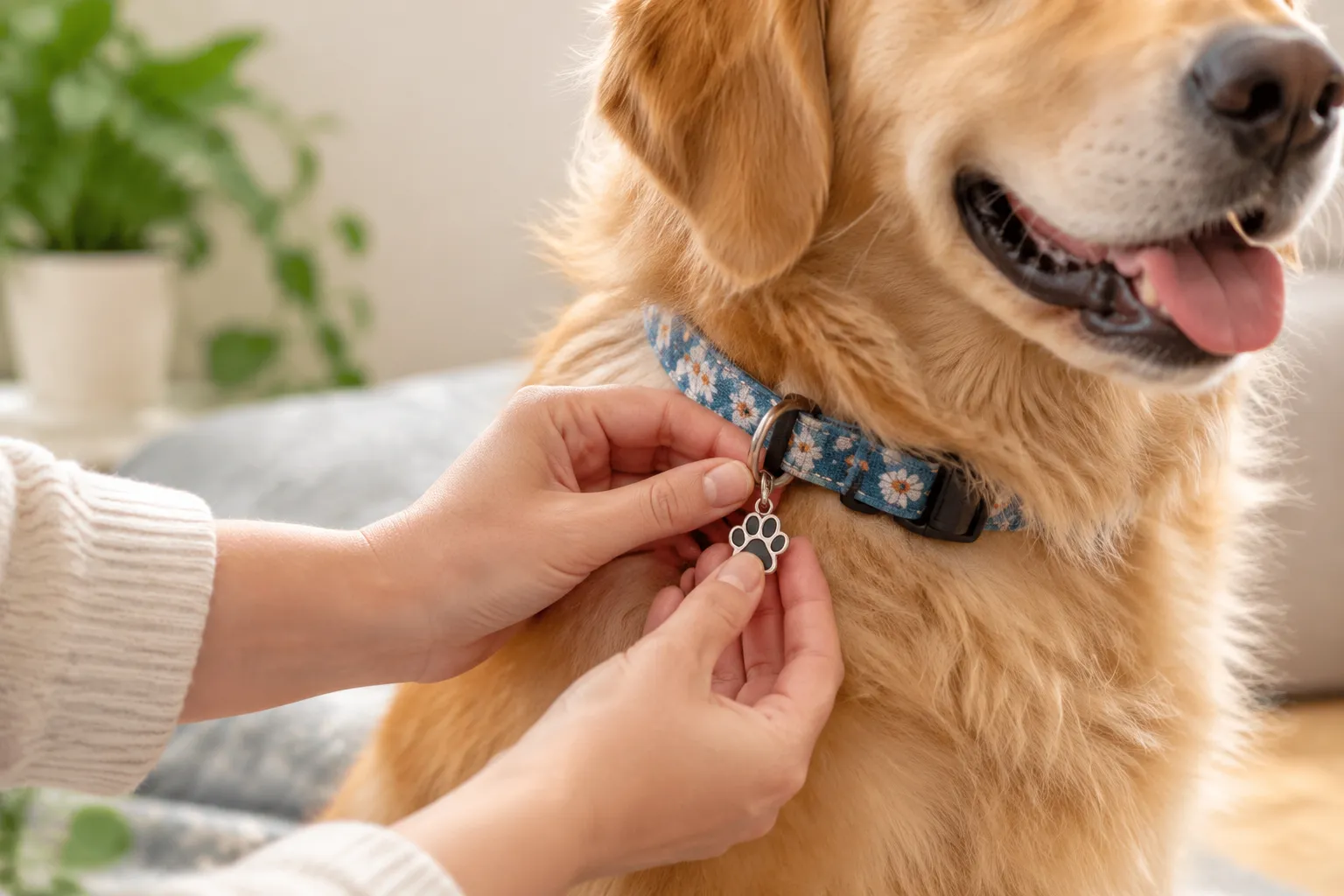
A charm dangling from a collar looks like decoration until the third mile of a muddy walk, when it has wrapped itself around a buckle, collected a burr the size of a marble, and started swinging hard enough to smack the dog in the throat. That is the moment the object stops being jewelry and starts being equipment. Pet fashion charms survive walks for the same reason good climbing gear survives a season: the makers assumed the worst ground, the worst weather, and the worst behavior, and built for that instead of the photoshoot.
The category is small and mostly unserious, which makes the durable examples easier to spot. A charm that lasts is a small piece of industrial design pretending to be cute. It has opinions about weight, attachment, finish, and what happens when a forty-pound dog decides to sprint at a squirrel. The ones that fall apart were designed for the shelf.
The Attachment Point Decides Almost Everything
Most charms die at the connection. A split ring from a keychain, the kind sold in bins near a hardware store register, will open under load because its wire is thin and its spring memory is poor. A dog shakes its head maybe a dozen times in a single walk, each shake producing a small whip-crack of force at the ring. Add a leash tug or a roll in the grass and the ring gradually deforms until it lets go somewhere between the front door and the corner.
The better hardware is boring and heavy: a welded stainless ring, a small carabiner with a screw gate, a swivel snap with a proper barrel. Weight matters here in a way that surprises people. A charm heavier than a few ounces on a small dog's collar turns into a pendulum, and a pendulum on a moving animal is a bruise waiting to happen. The rule of thumb that circulates among people who make working dog gear is that the total dangle should stay under roughly ten percent of what the collar itself weighs, which for a typical nylon collar means a charm of an ounce or two at most.
Hardware also has to resist the specific chemistry of a dog's life. Zinc alloy castings, the cheap silver-colored metal behind most novelty charms, corrode fast when exposed to urine, pond water, and the salts in road grit. A plated finish that looks bright in the package will pit within a month of regular walks in wet weather. Solid brass, stainless steel, and anodized aluminum all hold up. The trade-off is that they cost more and weigh more, which pushes the design toward smaller, denser shapes rather than big hollow ones.
Swivels Are Not Optional
Any charm hanging from a collar needs a swivel between the ring and the body of the charm. Without one, the charm twists the collar webbing into a spiral, and a twisted collar sits unevenly on the neck and can rub. With one, the charm spins freely and the collar stays flat. Swivels are cheap and tiny, a few millimeters across, and their absence is the clearest sign that a charm was designed by someone who never watched a dog walk.
The swivel itself has a failure mode worth knowing. Cheap swivels seize when grit works into the barrel, and a seized swivel is worse than no swivel because it transfers all the twisting force straight into the charm's eyelet. Eyelets pull out. A charm with a cast-in loop and a good swivel will outlast three charms with soldered loops and no swivel, and the difference shows up on the first rainy week of the season.
Edges, Burrs, and the Physics of a Head Shake
A dog's head shake produces acceleration that can briefly exceed what the animal experiences running flat out. A charm on a collar gets flung outward at the end of that arc, then snaps back. Anything with a sharp edge or a protruding pin will, over a few hundred shakes, wear a hole in the collar webbing or catch in the dog's fur. Cast metal is especially prone to this because the mold seam runs around the perimeter, leaving a ridge that looks smooth until it has been against a neck for a month.
Tumbled, polished edges are the fix, and they are easy to feel for with a thumb. A charm that passes the thumb test around its full perimeter, with no catch at the eyelet or along the back, is a charm that will not chew through a collar. The same test applies to the back face. A flat back sits better against webbing than a domed one, and a back with a visible pin or rivet head is a friction point.
Size enters here too. A charm the size of a half-dollar on a medium dog's collar will bang against the breastbone on every stride, and the dog will learn to walk slightly sideways to avoid it. Small and dense beats large and hollow, both for durability and for the animal's comfort. The charm should read clearly at a glance but disappear into the motion of the walk.
The Finish Has to Survive More Than Rain
Paint, enamel, and powder coat all fail differently. Enamel, the glass-based coating used on better decorative pieces, chips when struck against concrete or a metal fence, and once a chip starts, moisture gets under the edge and lifts the rest. Powder coat is more flexible and resists chipping better, but it fades under UV and wears through at the high-contact points first. Paint, the kind on inexpensive stamped charms, flakes off in sheets within weeks.
Solid metal with a brushed or tumbled finish is the most durable option, full stop. It shows scratches, but scratches on solid brass or stainless steel are cosmetic and can be polished out. Plated finishes sit in the middle: good plating over a solid substrate lasts years, thin plating over pot metal fails fast. The tell is the weight and the price. A charm that feels substantial for its size and costs more than a fast-food meal is probably solid. A charm that feels light and costs less than a coffee is probably plated pot metal.
Engraving and stamped lettering survive better than applied lettering. Raised enamel lettering catches on fur and wears at the high points; recessed engraving fills with dirt but keeps its edges. A charm with a deep engraving can be scrubbed with a toothbrush and look nearly new after a season of walks.
What Happens at the Dog Park
Off-leash play is a different stress test than a leashed walk. Two dogs wrestling will grab at anything dangling, and a charm is a handle. A charm that a playmate can bite and pull will either break or, worse, injure the wearer's neck when the collar twists. The solution most experienced owners land on is a breakaway or quick-release attachment for park days, or simply removing the charm before off-leash time.
This is where the design of the attachment earns its keep again. A small carabiner with a screw gate can be opened and closed in seconds with cold fingers, which means the charm actually comes off when it should. A split ring requires a fingernail and patience, so it stays on, and the charm goes to the park and takes the abuse. The best hardware is the hardware a person will actually operate.
Cleaning Is Part of Durability
A charm that cannot be cleaned will not last. Dirt and oils pack into crevices, hold moisture against the metal, and accelerate corrosion at exactly the points where the finish is thinnest. Charms with deep recesses, moving parts, or fabric inserts are harder to clean and fail sooner. Simple shapes with smooth surfaces wipe clean with a damp cloth and a little dish soap, and a quick dry with a towel keeps the swivel moving.
Stainless steel and brass tolerate a toothbrush and warm water. Plated pieces should avoid abrasive cleaners, which strip the plating faster than wear would. The charm should be dried, not left wet, especially the swivel and the eyelet, where water sits and starts the pitting that eventually cracks the metal.
The Collar Underneath Carries the Load
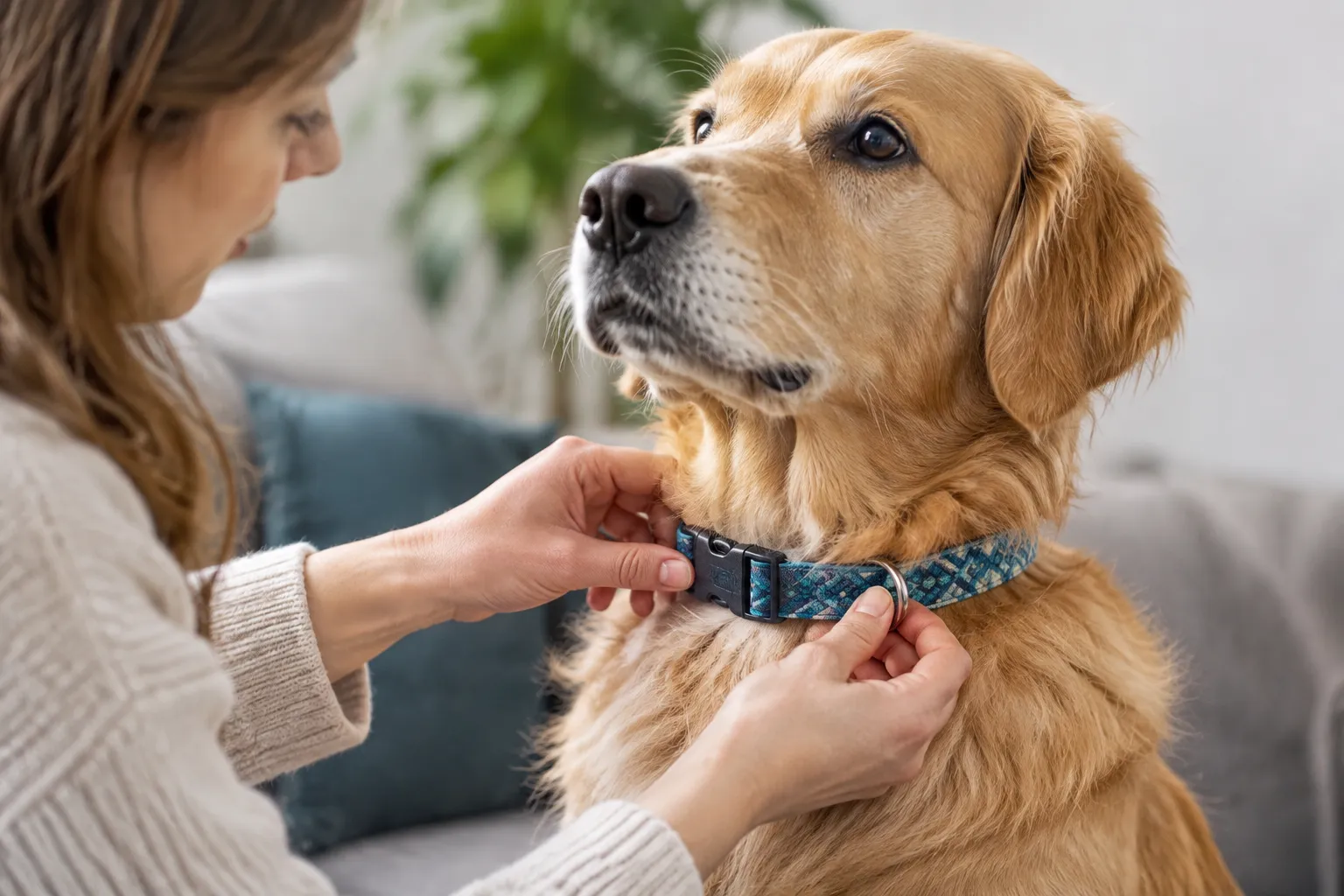
No charm survives a bad collar. A wide, well-stitched nylon or leather collar distributes the charm's weight and the force of a shake across more surface area, which reduces wear at the attachment point. A thin, flimsy collar concentrates all of that force on a single stitch line, and the charm's ring will eventually pull through the webbing. The collar's D-ring, where the leash attaches, is a separate load path and should never be the same ring the charm hangs from.
Owners who walk daily in wet climates tend to move toward leather collars treated with wax, or toward coated webbing that resists rot and odor. Both hold a charm better than untreated nylon, which absorbs water, stretches, and softens at the stitch holes. The charm and the collar are a system, and the weakest part of the system sets the lifespan of the whole.
A Charm That Lasts Looks Slightly Overbuilt
The charms that survive a year of daily walks share a family resemblance. They are small for their weight. The metal is solid and cool to the touch. The edges are rounded and the back is flat. A welded ring and a real swivel connect them to the collar, and the whole assembly can be removed in under five seconds. They cost more than the novelty charms in the impulse bin, and they look a little less delicate, which is the point.
The test is simple enough to run in a shop or at a kitchen table. Hang the charm from a finger by its ring and spin it. A good one turns freely and settles without wobble. Run a thumb around every edge. Shake it next to an ear and listen for anything loose inside. Weigh it in the hand against its size. Most of the charms that fail these checks will fail on the first walk, and the ones that pass will still be on the collar when the seasons turn and the mud comes back.