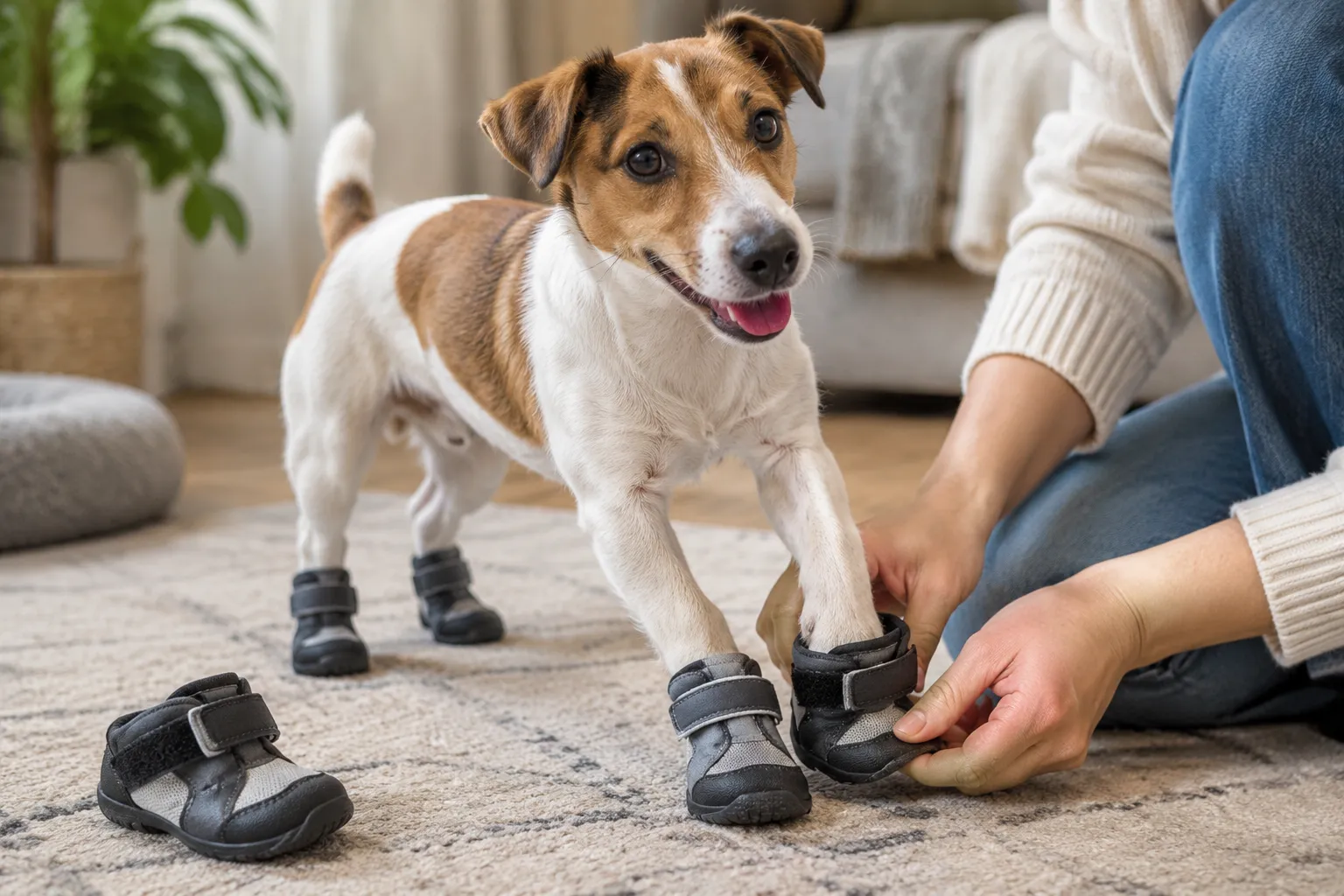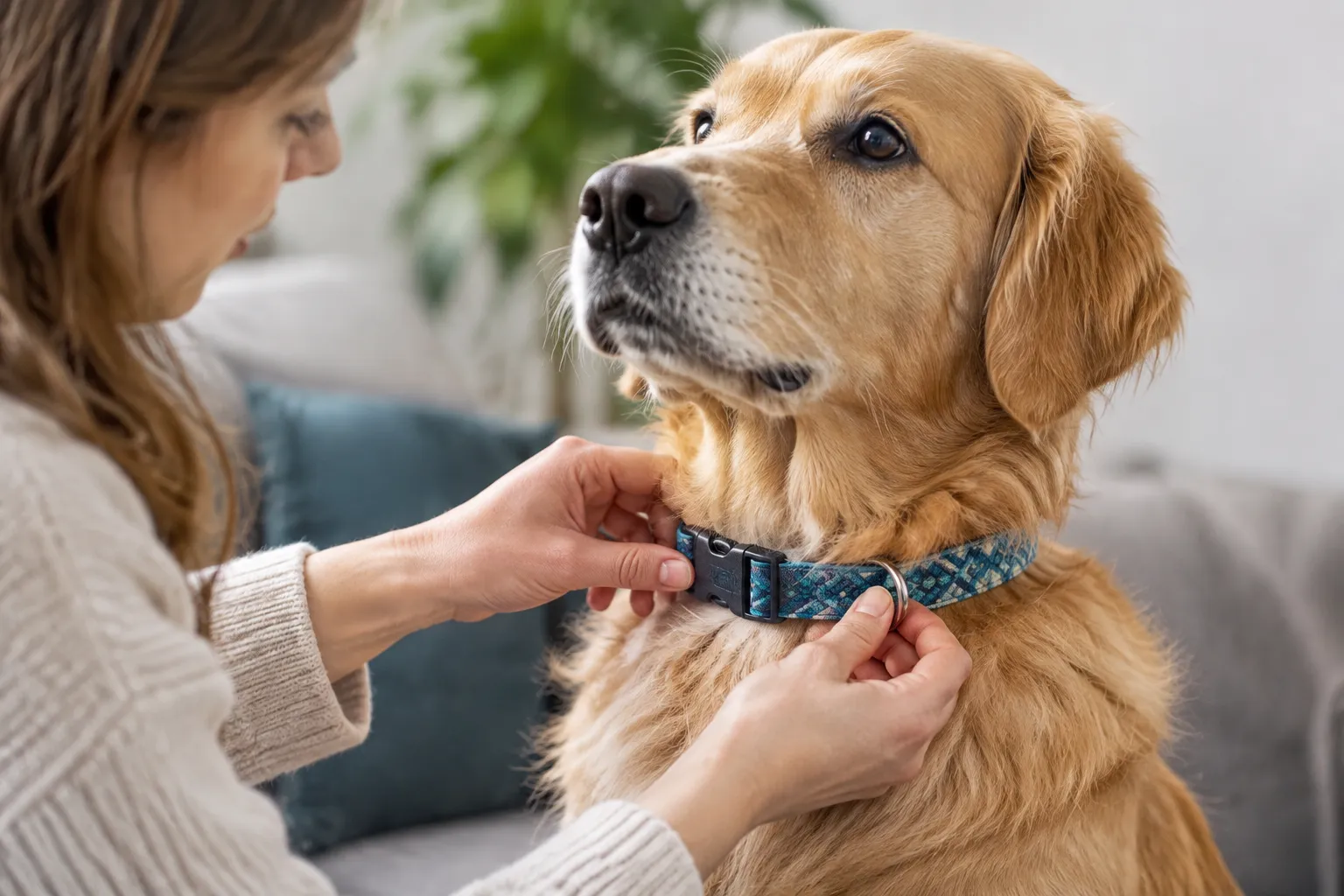
The charm looks harmless in the hand: a little brass fish, a dime-sized medallion, a tag shaped like a mountain. Then it goes onto a collar, and the collar goes onto a dog that sleeps in a crate, scratches behind one ear, and barrels through a hedge. A dangling piece of metal on a furry neck has to survive all of that without chewing a mat into the coat or catching on the first branch the dog dives under.
Most charm instructions stop at "attach to collar." That guidance is where the trouble starts. The mechanics of keeping a charm fur-safe are small and specific: where it sits, how much it weighs, what it swings against, and how the fur around it is maintained. Get those four things right and the charm becomes invisible in daily life. Get them wrong and a person ends up cutting a felted knot out of a golden retriever's ruff with nail scissors.
Fur Wraps Around Anything That Hangs
Long fur behaves like a slow-moving river around a collar. It sheds into every gap, and a charm that dangles on a loose ring gives that fur a place to collect. Each step the dog takes swings the charm, and each swing draws a few more hairs around the split ring. Over a week of walks, the loop becomes a felted collar of its own: a tight, matted ball of undercoat wound around the hardware.
The tighter the fur, the worse the problem. A short-coated dog like a boxer barely notices a hanging tag. A collie, a husky, or a spaniel with feathering behind the ears will collect a knot around a swinging charm within days. The prevention is geometric, not chemical: keep the charm close to the collar band, and keep the fur around it trimmed or combed so hair has nothing to wrap around.
Charm placement matters for a second reason. A charm that hangs below the collar band rests against the chest, where a dog's front legs come up during a run. A charm that sits to the side near the buckle bumps the neck as the head turns. The safest spot is flat against the collar band itself, where the charm can move with the collar instead of swinging freely beneath it.
Rings, Clips, and the Snag Inventory
Every attachment point on a charm is a potential snag. A split ring, the classic keychain style, has a small gap where the two ends meet; fur finds that gap and wedges in. A lobster clasp has a spring-loaded jaw that can pinch a thin layer of skin if the dog scratches at it. An S-hook, the kind sold for handbag charms, is open on both ends and slides free with a good shake.
For fur, the least troublesome connector is a small, welded O-ring or a solid trigger clip with a covered spring. Welded rings have no gap. A trigger clip with a fabric or silicone cover over the spring keeps hair out of the mechanism. Whichever connector is chosen, it should be small enough that the charm does not dangle more than an inch below the collar band. An inch of swing is a pendulum; three inches is a snare.
The charm itself deserves a look, too. Flat charms with rounded edges slide past fur. Charms with sharp corners, spiky protrusions, or open filigree catch hair on the way in and hold it on the way out. A charm shaped like a star with pointed tips will snag a coat more reliably than a smooth disc of the same weight. For a long-haired dog, the shape of the charm is as important as the attachment.
Weight Limits for a Hanging Object
A collar charm is not a fashion accessory alone; it is a small weight hanging from a band around the neck. The general rule among trainers and veterinarians is that anything hanging from a collar should stay light, measured in ounces rather than pounds. A charm that weighs several ounces on a small dog will bounce against the throat with every stride, and a dog that dislikes the bouncing will scratch at the collar until the fur around it is worn thin.
Weight also affects how the charm behaves in fur. A heavy charm pulls the collar band down and away from the neck, creating a gap where long hair slips underneath. A light charm stays put against the band and moves with it. For a dog under about fifteen pounds, a charm should weigh no more than a few ounces; for a large dog, the ceiling is higher, but the principle holds. The charm should feel like part of the collar, not like cargo.
There is a behavioral test that says more than any scale. Put the charm on the collar, let the dog walk around the yard for ten minutes, and watch the neck. A dog that stops to scratch at the collar, shakes its head repeatedly, or rubs its neck against furniture is telling the handler the charm is too heavy, too swingy, or sitting in the wrong place. A dog that ignores it entirely has passed.
The Collar Band Itself Has to Cooperate
A charm attached to a frayed nylon collar will snag on the collar before it ever snags on fur. Worn webbing develops loose threads that loop around ring hardware and pull. A collar with a rolled leather edge or a smooth, tightly woven band gives the charm a clean surface to sit against. The collar should also fit snugly enough that it does not rotate freely; a collar that spins around the neck drags the charm through the ruff on every turn.
Buckle placement is part of the geometry. On a collar with a plastic side-release buckle, the buckle sits at the side of the neck, and a charm hung near it will bump the buckle housing with every head turn. Moving the charm to the opposite side of the D-ring spreads the hardware out. On a collar with a traditional metal buckle, the charm can sit on the D-ring at the front, where it stays clear of the buckle prong.
The D-ring is usually the best anchor because it is welded to the collar and sits at the front of the neck. A charm clipped to the D-ring hangs at the throat, which is a relatively flat area on most dogs and away from the heavy feathering behind the ears. The trade-off is that the D-ring is also where the leash attaches. A charm on the same ring as the leash clip will get knocked around during walks, so a small secondary ring welded just beside the D-ring is a better home for the charm.
Grooming Around a Permanent Accessory
Once a charm lives on a collar, the fur around it needs a little more attention than the rest of the coat. The area under and around the charm should be combed out every few days, especially on double-coated breeds that are shedding. A slicker brush or a metal comb run through the neck ruff after each walk takes thirty seconds and prevents the slow felted knot that forms when loose hair wraps around a ring.
For long-haired dogs, a small trim around the charm's resting spot is worth considering. Not a shave, just a light scissor trim of the fur directly beneath the charm, maybe a quarter inch, so the hair has less length to wrap. This is the same logic groomers use around a collar line on a spaniel: keep the fur short where hardware sits, and let it grow long everywhere else. The trim is invisible once the collar is on, and it removes the main site where mats begin.
Bathing changes the equation, too. Wet fur clings to hardware far more aggressively than dry fur, and a charm left on during a bath will collect a wet knot that dries into a hard mat. The charm should come off before a bath and go back on once the coat is fully dry and combed. The same applies after a swim in a pond or a run in the rain: dry the neck, comb the ruff, then reattach.
When the Charm Belongs on a Harness Instead
Some dogs should not wear a charm on the collar at all. Dogs with very long, fine coats, dogs that scratch at their necks, and dogs with sensitive skin around the throat are better served by a charm clipped to a harness. A harness spreads weight across the chest and back, and a charm attached to a D-ring on the back of a harness sits above the fur line rather than buried in it. The charm still needs to be light and smooth-edged, but the snag risk drops sharply because the harness band is wider and the charm hangs over a shorter coat area.
For a dog that wears a harness on walks and a collar around the house, the charm can move between them. A small trigger clip with a covered spring makes the transfer easy and keeps the charm from being left on a collar during crate time, when a dog is most likely to scratch at a hanging object. The charm becomes part of the walking outfit, not a permanent fixture on the neck.
The Ten-Minute Check Before the First Walk
Before a new charm goes on a walk, a short inspection catches most of the problems that would otherwise show up as a mat three days later. The charm should hang no more than an inch below the collar band. The connector should have no open gap where fur can wedge. The charm edges should be smooth when a thumb runs along them. The collar should sit snug enough that it does not rotate, and the charm should be positioned away from the buckle and away from the leash clip.
Then the dog gets ten minutes in the yard, and the handler watches the neck. A dog that ignores the charm has a charm that fits. A dog that scratches, shakes, or rubs has one that needs to move, lighten, or come off. The charm that passes both the inspection and the yard test will usually stay fur-safe through a full season of walks, and the coat around it will stay as smooth as the day the collar went on.