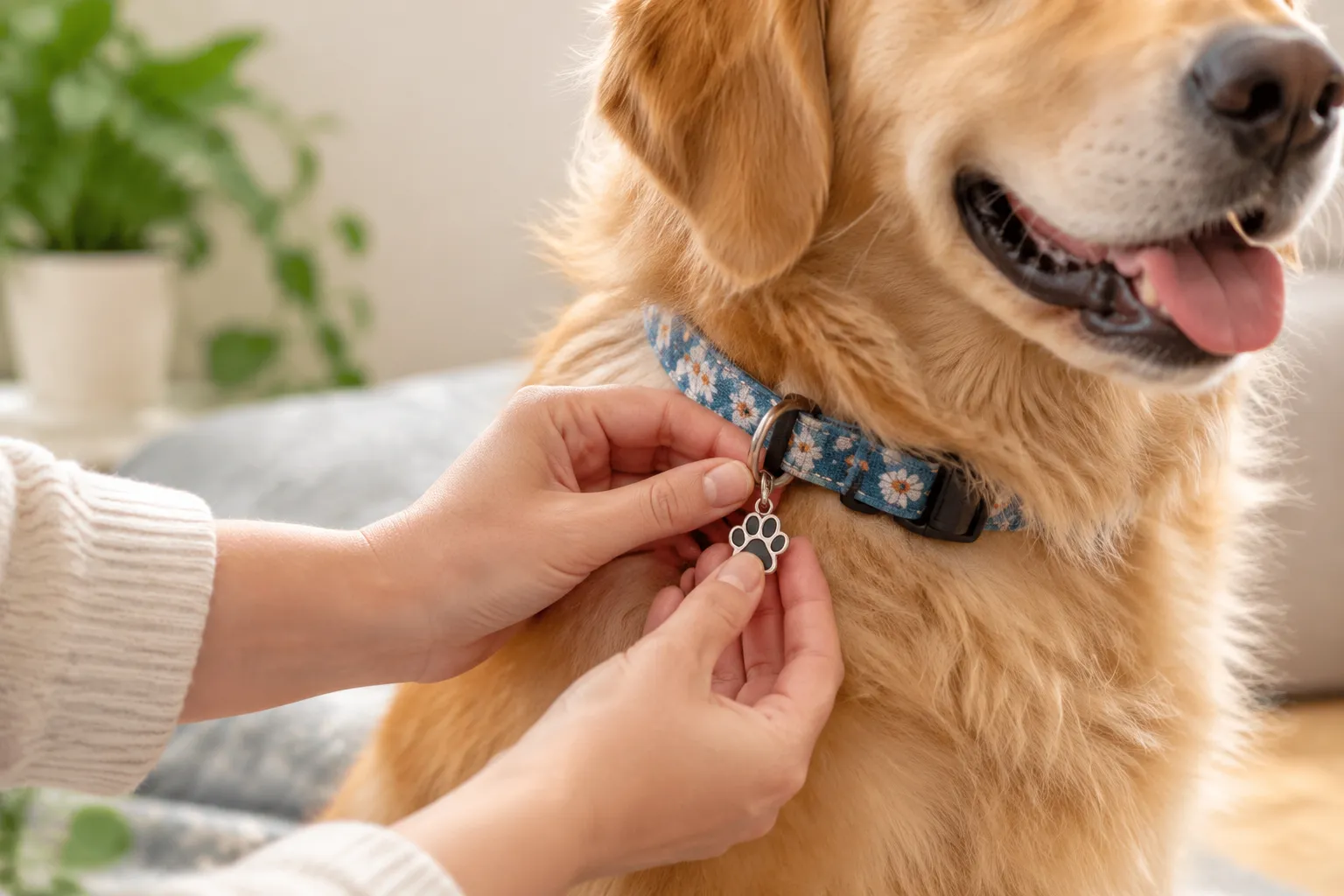
A custom leather tag costs about fifteen dollars and arrives in a padded envelope three days after ordering. A hand-embroidered bandana takes an evening of stitching and a length of cotton cloth that costs almost nothing. Both get called thoughtful gifts by the people who give them. Only one survives the first wash cycle of the relationship.
The comparison is worth taking seriously because these two objects sit at opposite ends of a spectrum that gift-givers rarely name out loud. One is manufactured, stamped, printed, or engraved, produced with a machine and a mailing address. The other is made by hand, sometimes by the giver, and carries the small irregularities that come with human effort. Choosing between them means choosing what kind of gift the occasion actually calls for.
What a Personalized Tag Actually Is
The personalized tag comes in several forms. In its most common version it is a small metal or leather plate, rectangular or shield-shaped, often two inches across, engraved with a name, a date, or a short line of text. It gets attached to a collar, a bag, a keychain, a set of luggage handles, a pet's collar, or a zipper pull. The material matters more than most buyers realize: brass and stainless steel hold up for years, while cheap alloy plating wears through within months and leaves a dull gray patch where the name used to be.
Leather tags offer a warmer surface. A small laser-etched leather disc, maybe an inch and a half in diameter, reads like part of the object rather than an addition to it. On a canvas tote or a well-used backpack, that matters. On a formal gift, it can feel out of place.
The real draw is precision. Names, dates, initials, a short phrase: the tag does exactly what was asked, in a clean font, every time. There is no wobble in the lettering, no thread pulling loose. The recipient's name is spelled correctly because a computer set it. That reliability is not a small thing when a gift is meant to mark an occasion.
The Bandana as a Canvas
An embroidered bandana starts as a square of cotton, usually around twenty-two inches on a side. The embroiderer works a design into a corner or along an edge: initials, a small motif, a date, a line of text in satin stitch. The result is a wearable object with the personal mark built into the fabric rather than attached to it.
The bandana carries a long history as a working garment, tied around the head or neck in dusty fields and on long rides, and that history gives it an easy familiarity. A bandana with a monogram in the corner reads as casual, useful, slightly rugged. It suits a certain kind of person almost perfectly: someone who wears denim, carries a canvas bag, walks rather than drives. On that person, an embroidered bandana looks like it was always meant to be there.
The problems start when the bandana meets a washing machine. Cotton shrinks, colors bleed, and embroidery thread, especially on a lightweight bandana, can pucker the fabric around it. A hand-stitched bandana needs gentle care to survive more than a season. That is fine for someone who will treat it gently. It is not fine for someone who treats a bandana the way bandanas are usually treated.
The Weight of Handmade
There is a category of gift-giver for whom the embroidery itself is the point. The hours spent with a needle, the visible irregularity of the stitches, the small proof that a person sat down and made something: these carry a message a purchased tag cannot. The bandana becomes an heirloom in the making, a physical record of the effort behind it.
That message only lands for the right recipient, though. A person who does not care about handmade objects will look at a slightly uneven monogram and see a slightly uneven monogram. The effort is invisible to anyone who is not already inclined to notice it. For that recipient, the tag wins without contest, because the tag delivers the personalization without demanding appreciation of the process.
How Each Gift Ages Over Years
Brass develops a patina. Stainless steel stays bright. Leather darkens and softens at the edges. A good tag, attached to a bag that gets used, becomes part of the object's history, and the engraved name stays legible through all of it. Ten years on, a brass tag on a leather bag looks like it was bought with the bag.
A bandana ages differently. Cotton thins. Color fades unevenly, often fastest where it folds. The embroidery, if well done, holds, but the fabric around it can develop small pulls and holes. Some owners love this. A worn bandana has character, and a bandana that has clearly been worn for years tells a story about the person wearing it.
The honest comparison is this: the tag ages by improving, the bandana ages by becoming more itself. Both can be good outcomes. Neither is a failure. What differs is how much maintenance each requires to get there.
The Recipient Who Never Uses Either
Gift-givers tend to imagine the recipient using the object daily. The reality is messier. A tag on a keychain gets used constantly because the keys get used constantly. A tag on a luggage handle gets used twice a year, which means it spends most of its life in a closet, but the two times it comes out, it earns its place.
A bandana has a narrower window of use. Someone who already wears bandanas will wear this one. Someone who does not will tuck it into a drawer and feel vaguely guilty about it. The gift presumes a style the recipient may not have. That presumption is not a flaw in the bandana; it is a mismatch between object and person, and it is the single most common way either gift fails.
The tag carries a lower presumption. It attaches to something the recipient already owns and already uses, which means it slots into an existing life instead of asking for a new one.
Cost, Effort, and What Gets Remembered
Dollars tell a strange story here. A quality engraved tag runs fifteen to forty dollars depending on material and customization. A handmade embroidered bandana, if the labor were priced at a fair hourly rate, would cost far more than anyone would pay for a bandana. The bandana is expensive in time and cheap in money; the tag is the reverse.
What gets remembered is not the cost. It is the moment of opening. A tag reveals its message instantly: the name, the date, the line of text, all visible in a glance. The bandana requires unfolding, and the embroidery is often small, tucked into a corner. The reveal is quieter, and for some recipients that quiet is exactly right. For others, the small scale reads as underwhelming after the box is opened.
The Occasion That Decides It
Occasions sort these two objects more cleanly than preferences do. A graduation, a new job, a wedding party favor, a milestone birthday: these call for something precise, legible, and easy to keep. The tag fits. It marks the event with a date and a name, and it stays attached to an object the recipient will keep using.
A housewarming, a long hike, a festival, a casual holiday exchange among friends who already trade handmade things: the bandana fits. It reads as warm, unfussy, and personal in a way that a small metal rectangle cannot quite manage.
The worst outcome for either gift is a mismatch with the occasion. A bandana given at a formal engagement party looks like a mistake. A tag given to someone who wanted a handmade object feels cold, like a gift picked from a dropdown menu.
The Practical Case for Owning Both
Most gift-givers treat this as a binary. It does not have to be. A tag and a bandana can be given together, and the combination covers both instincts: the precision of the engraved name, the warmth of the embroidered cloth. A small leather tag on the bandana itself, attached at one corner with a short leather cord, turns the bandana into a more finished object and gives the recipient both kinds of personalization at once.
That pairing also solves the presentation problem. The bandana unfolds to reveal the tag, and the tag carries the date or the message that the embroidery alone could not fit. The gift reads as considered rather than chosen from a list.
What the Choice Actually Reveals
The choice between a personalized tag and an embroidered bandana is a choice about how much the giver is willing to presume. The tag presumes nothing except that the recipient owns something worth labeling. The bandana presumes a style, a wardrobe, and a willingness to wear a square of cloth around the neck.
Givers who know the recipient well can afford the bandana's presumption. Givers who are guessing should reach for the tag. That is the whole decision, and it turns on information rather than taste.
A woman at a craft fair last autumn held up a bandana embroidered with a single initial in dark green thread and said she was buying it for her sister, who had worn the same faded bandana for years. That is a gift with almost no risk. The sister already lives in the object. The tag, by contrast, is the gift for the person whose life the giver can only partly see: a name on a keychain, a date on a luggage tag, a small metal rectangle that says the right thing without asking anything in return.