A jeweled collar spends most of its life in the least glamorous places: a water bowl, a mud puddle, the crook of a dog's neck after a long walk in August. The rhinestones catch light and the metal plate underneath catches grime, and the two facts cannot be separated. This is the central problem of cleaning one. The stones want gentleness and the hardware wants scrubbing, and the same cloth cannot do both without consequences.
Most damage to jeweled collars does not come from dirt. It comes from the cleaning itself: softened glue behind a stone, a scratched clasp, a gold-tone finish rubbed down to the base metal in a single afternoon of enthusiastic polishing. Knowing which parts of the collar tolerate what is most of the job.
What sits under a glued rhinestone
Cheap jeweled collars use glue. Better ones use prong settings or bezels. The distinction matters before any water touches the piece, because glued stones and water have a long, unhappy history together.
Water softens many craft adhesives. Soap accelerates it. A collar that gets dunked and left to dry on a counter can shed a stone a week later, and the loss usually gets blamed on the dog. Prong-set stones tolerate a damp cloth and a soft brush far better, though the prongs themselves bend if pressed.
The test is simple. Turn the collar over and look at the back of a stone. A small metal claw gripping the edge means a setting. A smooth pool of clear or yellowish material means glue. Yellowed glue is already failing; treat that collar as fragile from the first cleaning and plan to reglue stones eventually.
The case against the jewelry bowl
The instinct is to treat a jeweled collar like a piece of jewelry, which means warm water, a drop of dish soap, and a soak. That routine ruins collars.
Soaking does three bad things at once. It loosens adhesive under glued stones. It wicks moisture into the leather or nylon strap, which then dries stiff and cracked. And it lets dissolved dirt settle into the crevices around every setting, where it dries into a gray film that is harder to remove than the original grime.
A collar is an object that flexes constantly. Every soak-and-dry cycle stresses the bond between stone and metal, and the strap between hardware and fabric. Cleaning should remove dirt while adding as little moisture and movement as possible.
Dry first, then damp
The first pass on any jeweled collar is dry, and it removes more than people expect. A soft toothbrush worked along the strap lifts hair, dried mud, and the fine grit that dulls stones from underneath. A dry microfiber cloth wiped across the face of the stones pulls off surface oil and dust without pushing anything into the settings.
Work over a towel. Loose stones that were already failing will fall out during brushing, and a towel catches them. A stone recovered from the towel can be reglued; one that bounces under the refrigerator cannot.
Only after the dry pass does a damp cloth come out, and it should be barely damp. Wring it until no water comes out, then wipe. The goal is a cloth that leaves a faint haze of moisture that evaporates in seconds, not a wet surface that sits.
Keeping water off the metal plate
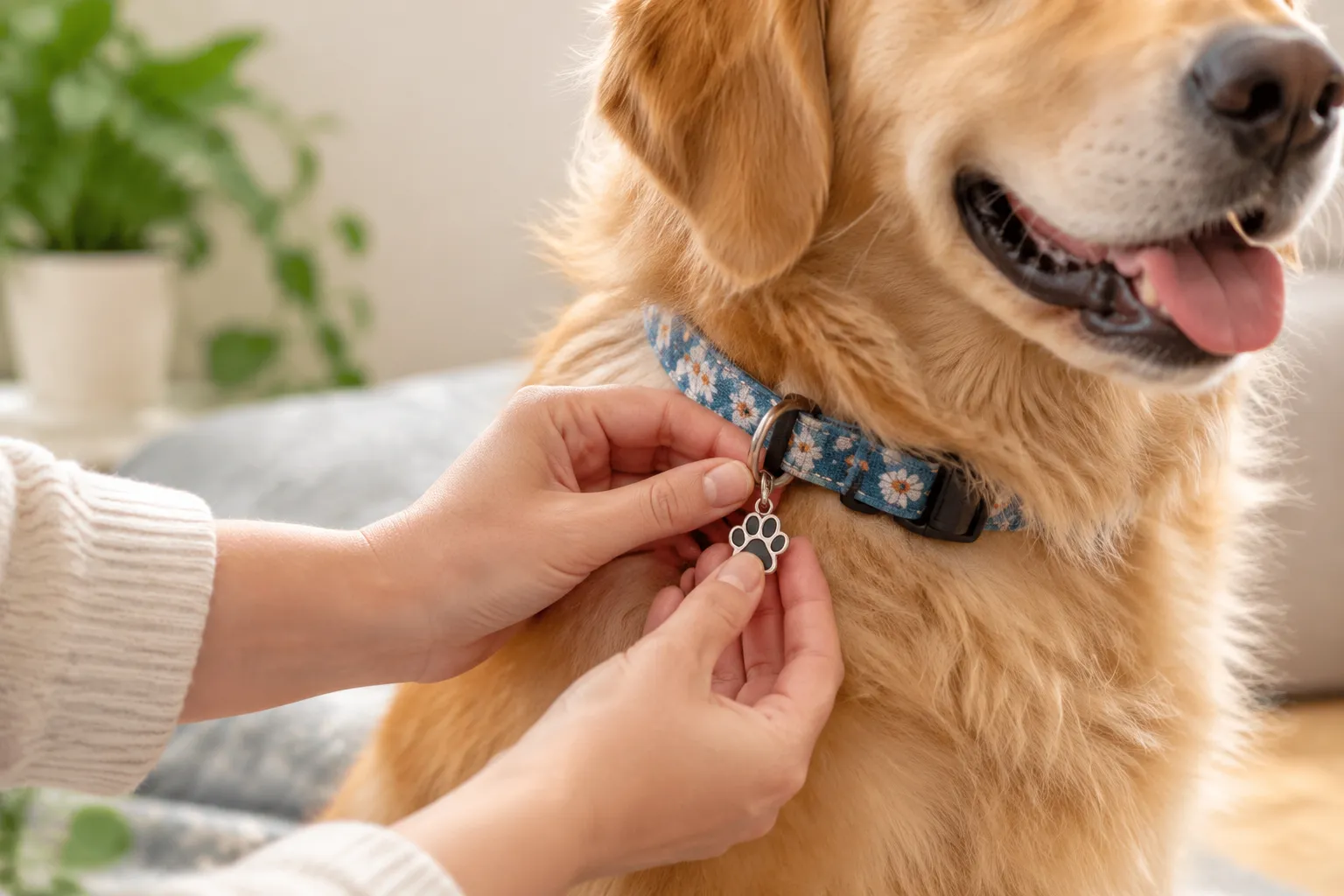
The engraved nameplate or ID tag is usually the most expensive metal on the collar and the most exposed. It is also where water does the most visible damage: gold-tone plating clouds, brass darkens, and stainless steel picks up water spots that etch if left.
Wipe the plate with the damp cloth, then dry it immediately with a separate dry cloth. Do not let it air dry. Air drying leaves mineral deposits in the engraved letters, which turn into dark crust that needs a toothpick to remove.
For grime packed into engraving, a wooden toothpick does more than a brush and cannot scratch the plate. Work along the groove, not across it. Metal polish is a last resort and should stay off any surface near stones, since polish residue dries white in the crevices around settings.
The clasp and the D-ring need oil, not soap
Hardware fails at the joints. A lobster clasp that sticks, a D-ring that squeaks, a buckle that has gone stiff: these are lubrication problems, and soap makes them worse by stripping whatever oil remains.
A single drop of light machine oil on the hinge of a clasp, worked open and closed a few times, restores most sticky hardware. Wipe off the excess with a cloth so it does not migrate onto the strap or the stones. Mineral oil works too, though it is thicker and attracts dust.
Skip the WD-40. It is a solvent, not a lubricant, and it leaves a film that collects grit in exactly the places a clasp needs to move freely.
When the strap is leather and the stones are not
Leather straps and jeweled settings are a difficult pairing because leather wants conditioner and stones want nothing oily near them. Conditioner that reaches the back of a glued stone will loosen the adhesive; conditioner that sits on the leather surface near a setting will darken the leather unevenly.
The workable method is to condition the leather first, on the underside and edges only, with a fingertip and a very small amount of product. Let it absorb for an hour. Then clean the jeweled face with the dry-then-damp method, keeping the damp cloth away from the conditioned areas until they have fully dried.
Nylon and polyester webbing are easier. They tolerate a damp cloth and a soft brush, and they dry fast enough that moisture does not sit against the settings. The one rule for webbing is to rinse the brush between passes, since grit trapped in the bristles scratches the finish on the next stroke.
Drying flat, away from heat
A cleaned collar should dry flat on a towel, jeweled side up, in a room with moving air. Not on a radiator, not in direct sun, not hanging from a hook. Heat softens adhesive and warps leather; hanging stretches a wet strap out of shape.
Give it several hours. A collar that feels dry on the surface can still hold moisture in the strap's core, and putting it back on a dog too soon traps that moisture against the neck, where it grows smell and mildew. Overnight is not excessive.
The stone that comes loose anyway
Sooner or later a stone falls out, and the collar is not finished. A flat-back rhinestone can be reset with a small drop of clear jewelry adhesive on the tip of a toothpick, pressed into place, and left undisturbed for a full day. The temptation to use super glue is strong and should be resisted: cyanoacrylate turns white and brittle, and it fogs the foil backing that gives a rhinestone its sparkle.
For prong settings, a wooden toothpick can gently press a bent prong back over the stone's edge. Too much pressure cracks the stone. Work slowly, check the grip after each small adjustment, and stop when the stone no longer shifts.
A weekly wipe beats a seasonal rescue
The collars that survive years of wear are not the ones that get deep-cleaned often. They are the ones that get wiped down after every muddy walk, before the grime has a chance to set into the settings and the strap.
A dry microfiber cloth kept near the leash hook does most of this work. Thirty seconds after a wet walk, while the collar is still on the dog and the mud is still soft, removes what would otherwise take a toothbrush and a damp cloth a week later. The deep clean then becomes rare, and the hardware lasts.
The collar that gets put away dirty is the one that comes out with clouded plating and a strap that smells faintly of pond. The one wiped down and laid flat to dry is the one that still catches light on the stones a year from now, with the nameplate still legible and the clasp still clicking shut.