Rose gold is the hardest metal finish to photograph honestly. Chrome throws light back at the lens and reads as silver in half the frames. Yellow gold goes brassy under warm indoor bulbs. Rose gold sits in a narrow band between pink and copper, and a camera sensor will happily push it toward either one depending on the white balance. A collar can look like a piece of jewelry in the hand and like a cheap copper chain on Instagram.
The collars below share one useful property: they photograph clean. That means the metal has a consistent tone across the strap, the hardware does not flare, and the finish holds its color under both daylight and the flat light of a phone flash. None of that guarantees a good fit or a comfortable dog. It just means the collar will not betray a person at the moment of taking the picture.
What "photographs clean" actually means for a collar
Three things separate a rose gold collar that shoots well from one that does not. The first is plating thickness and consistency. Thin plating on a stamped buckle develops a patchy, mottled sheen within weeks, and mottled metal catches light unevenly. A thicker, more even layer reads as one continuous surface.
The second is the relationship between hardware and strap. A rose gold buckle on a strap with a different undertone (a cool gray leather, a stark white webbing) creates a color clash the camera exaggerates. Matching the undertone, warm leathers, cream webbing, blush nylon, keeps the image coherent.
The third is surface finish. High-polish rose gold is a mirror and will reflect whatever is in front of it: a window, a hand, a green lawn. Brushed or satin finishes scatter light and hold their color. For photography, a soft brushed finish almost always wins.
The eight collars, and why each one holds up on camera
A few of these are jewelry-adjacent pieces that cost real money. A few are under thirty dollars. The list is organized by what each one does well rather than by price, because price and photogenic quality are only loosely correlated in this category.
1. A brushed rose gold buckle on full-grain leather
This is the reference point. Full-grain leather in a warm tan or cognac, a solid brass buckle with rose gold plating, and a keeper that matches. The leather darkens with wear and the metal keeps its tone, so the collar looks better at six months than at purchase. The brushed buckle refuses to flare under flash. Photographs of this combination tend to look like they were taken by someone who knew what they were doing, even when they were not.
2. Rose gold hardware on blush or cream webbing
Nylon webbing takes color differently than leather, and a rose gold D-ring against a soft blush strap produces a low-contrast, almost monochrome image that reads as deliberate. The catch: cheap webbing pills and fuzzes, and fuzz on a strap is the first thing a camera picks up in a close crop. Look for a tight weave and a hardware finish that is satin rather than mirror.
3. A thin martingale in rose gold and suede
Martingales are the sleeper in this category. The limited-slip loop gives a clean, continuous line around the neck, and suede has a matte surface that absorbs light instead of bouncing it. A slim rose gold chain or plate on the loop photographs as a single bright accent against a soft field. The piece looks more expensive than it is, which is a useful property in a photograph.
4. Rose gold plate on a rolled leather collar
Rolled leather is a cylindrical strap, usually used on small breeds, and it has almost no flat surface to catch a reflection. That makes it unusually forgiving under a phone flash. A small rose gold plate riveted to the roll sits proud of the surface and reads as a clean dot of color. The risk is the rivets: poorly set rivets leave a shadow line that looks like damage in a photo. Inspect the hardware before buying.
5. A rose gold buckle on a wide, plain collar
Wide collars (an inch and a half and up) photograph well because the strap becomes the subject and the hardware becomes a detail. A plain rose gold buckle centered on a wide, unembellished strap looks calm and deliberate. This is the collar for a large dog whose owner wants the metal to read as an accent rather than the whole story. The finish matters more here: a wide buckle has more surface area to show plating flaws.
6. Rose gold accents on a braided or woven strap
Braided leather creates texture, and texture is a photographer's friend. A rose gold buckle and D-ring on a braided strap produce depth in the frame, with highlights landing on the braid and the metal catching a softer version of the same light. The color harmony holds because braided leathers tend to run warm. This is a good choice for anyone who wants the collar to look handmade in a picture.
7. A rose gold nameplate on a slim collar
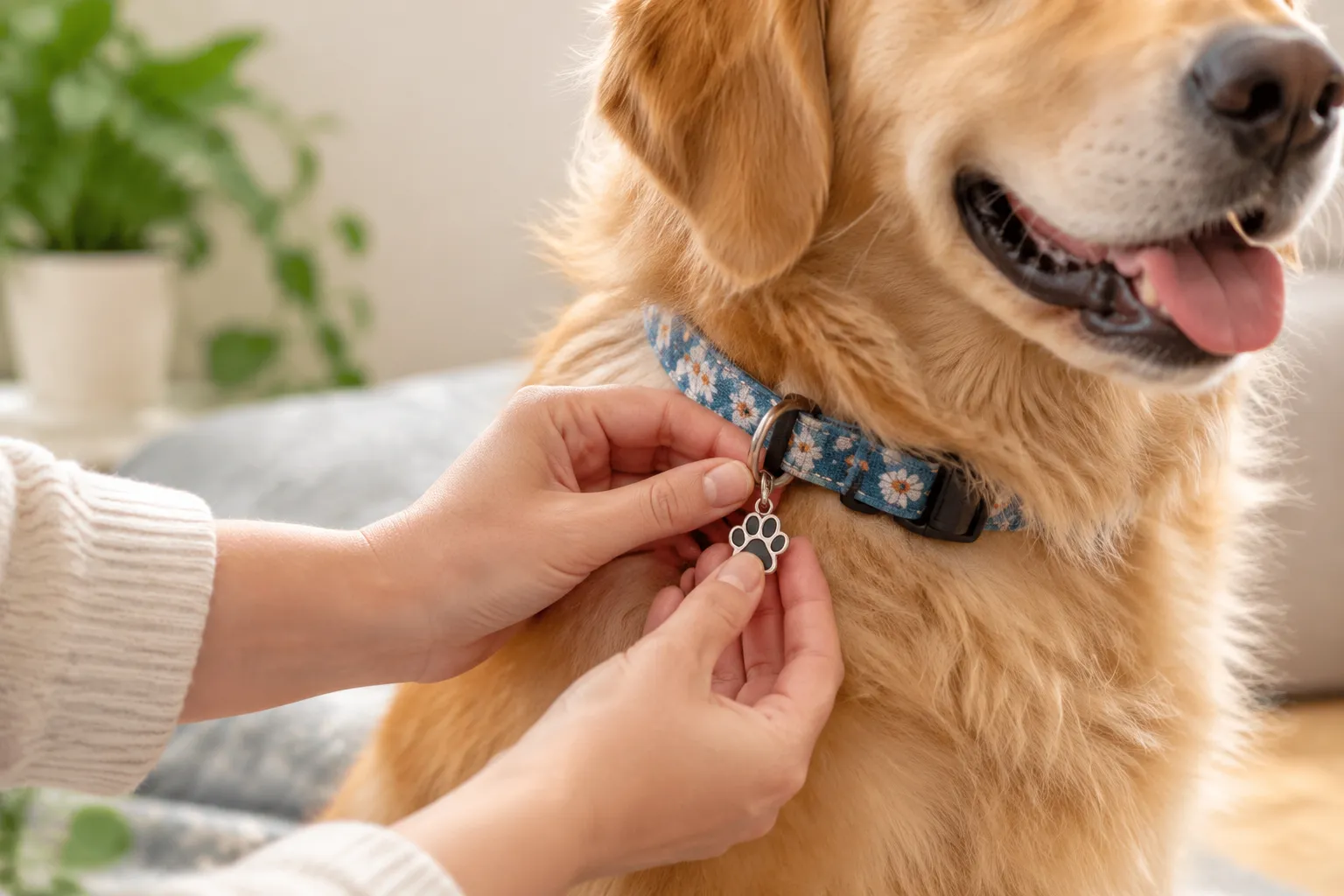
Nameplates are the most photographed part of any collar, and a rose gold plate with engraved text is legible in a phone shot if the engraving is deep enough. Shallow laser engraving on rose gold disappears under direct light. Deep rotary engraving holds a shadow line and reads clearly. A slim strap keeps the plate prominent, and the ratio of metal to strap is what makes the image work.
8. A matching rose gold leash-and-collar set
Sets photograph better than singles because the eye reads repetition as intentional design. A collar and leash in the same rose gold hardware and the same strap color create a coherent frame, and the leash gives the photographer a line to work with, leading the eye into the image. The practical warning: sets are often made with thinner plating to hit a price point, so the hardware on both pieces needs checking.
The lighting problem that ruins most rose gold photos
Most bad rose gold photos are white balance failures, not hardware failures. A phone camera set to auto white balance will see a warm-toned collar against a warm-toned background and decide the scene is too orange, cooling it until the rose gold turns silver. The same collar under a cool LED will be pushed pink to compensate.
The fix is boring: shoot in indirect daylight, near a window but out of direct sun, and lock the white balance if the camera allows it. A sheet of white paper in the frame as a reference helps the camera settle. The collars on this list are forgiving, but forgiveness has limits. A mirror-polished buckle under direct noon sun will blow out into a white smear no matter how good the plating is.
Plating durability and the six-month test
The honest limitation of nearly every rose gold collar is plating wear. Rose gold is an alloy of gold and copper, and the color depends on the ratio, which is why solid rose gold is expensive and plated rose gold is common. Plated hardware on a collar takes daily abrasion from buckles, tags, and the dog's own scratching. A collar worn daily will show wear at the D-ring and the buckle tongue within months.
For photography purposes, that wear matters less than it sounds. A slightly worn rose gold finish photographs warmer and more natural than a fresh mirror finish. The pieces that age badly are the ones with thin plating over a bright base metal, because the wear exposes a silver or nickel tone that clashes with the remaining rose gold. Solid brass or stainless steel underneath ages more gracefully than zinc alloy.
Sizing and fit for a photograph, not just a walk
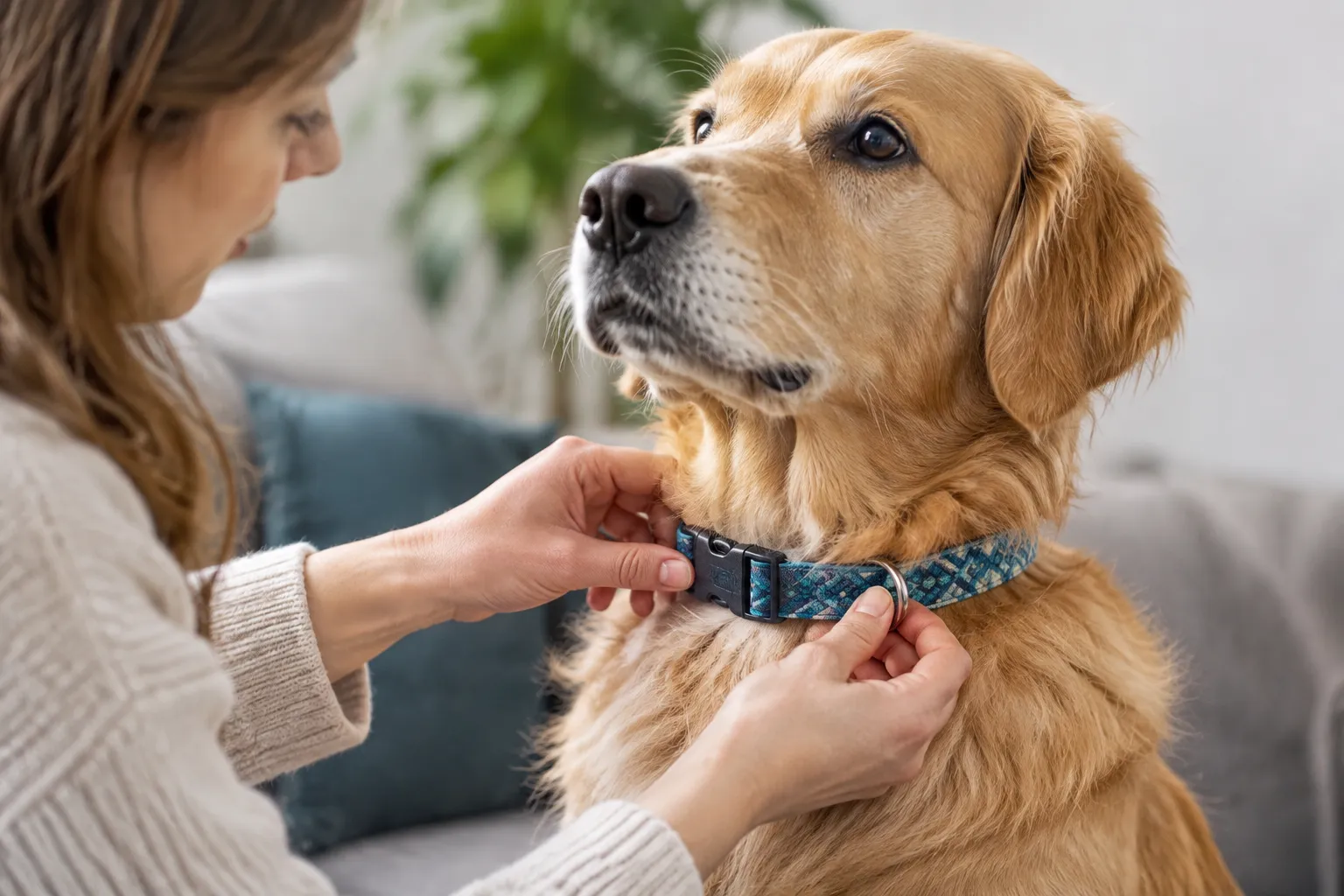
A collar that fits well photographs well. Too loose, and the hardware hangs away from the neck and catches light at a bad angle. Too tight, and the strap buckles, which breaks the clean line. The standard rule is two fingers of slack under the strap, measured at the widest part of the neck, and that rule holds for photography too.
One practical note for anyone photographing a dog in a new collar: the tag hangs and swings, and a swinging tag is the most common source of blur in a close shot. A tag silencer, a small neoprene sleeve, keeps the tag flat against the strap and removes the problem. It also keeps the rose gold tag from clinking against the buckle and scuffing it.
Where the cheap ones fail and the expensive ones justify themselves
Under about twenty-five dollars, the most common failure is a stamped buckle with plating so thin that the edges show base metal out of the box. Those edges catch light as bright silver lines and ruin the color continuity in a photo. Between twenty-five and sixty dollars, the plating is usually adequate and the strap material becomes the variable: bonded leather that peels, webbing that fuzzes, suede that stains.
Above sixty dollars, the money goes into solid hardware, hand-finished edges, and leather that will darken rather than crack. For a collar that will appear in photographs for years, the difference between a thirty-dollar piece and a ninety-dollar piece is mostly how it looks in year three. A person buying for a single photoshoot can stay low. A person buying for a decade should not.
A note on rose gold and coat color
Rose gold reads differently against different coats, and this is the variable most buyers ignore. Against a black or dark brown coat, the metal pops and the photograph has natural contrast. Against a golden or cream coat, the collar and the dog merge into one warm tone, which can look elegant or muddy depending on the light. Against a gray or blue coat, rose gold is the strongest pairing on this list, because the warm metal against a cool coat creates a color tension the camera loves.
The collar that photographs cleanest on a given dog is often the one that contrasts with the coat rather than matches it. That is worth a moment of thought before buying, because the difference between a collar that disappears into the fur and one that reads as a deliberate choice is usually just a shift in tone.